Today, in this blog post ‘Weathering the Storm in Ersama Summary Class 9 English’, we’ll read short & detailed summary of the chapter Weathering the Storm in Ersama by Harsh Mander from Class 9th NCERT English Moments(supplementary) Chapter 6 that will help you to understand this chapter better so that you can score best in your exam.
This post is a complete and easy-to-understand guide for your Class 9 English Moments Chapter “Weathering the Storm in Ersama”.
About the Chapter
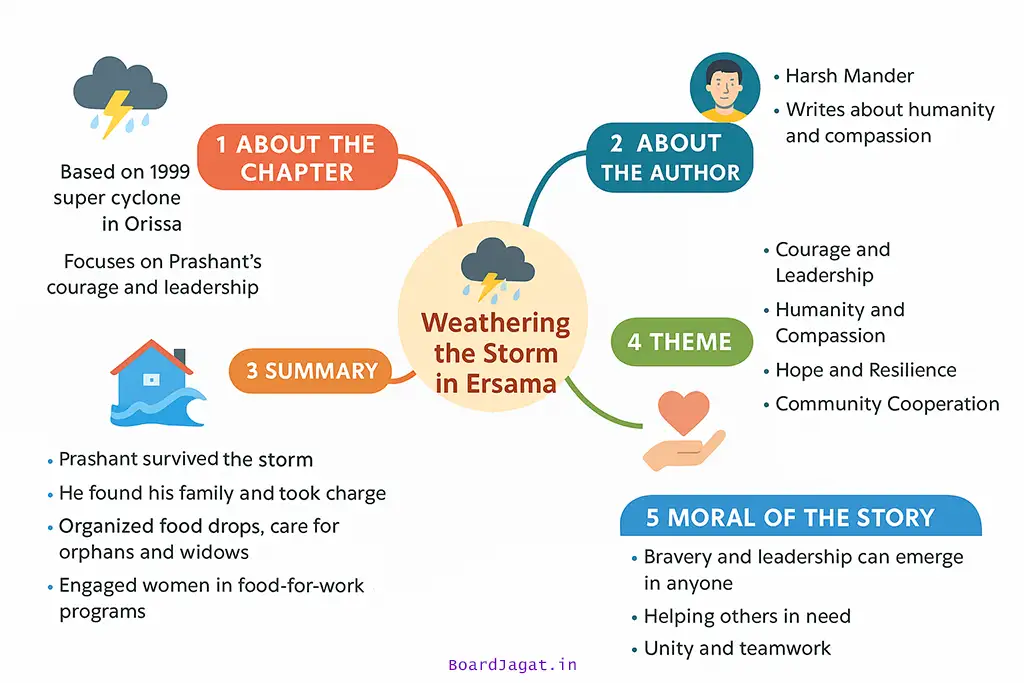
“Weathering the Storm in Ersama” is a real-life story based on the 1999 super cyclone in Orissa (now Odisha) that destroyed thousands of lives and homes. The story focuses on Prashant, a nineteen-year-old boy, who shows great courage and leadership during the disaster.
Despite losing almost everything, Prashant helps his village survive, rebuild, and recover. The story teaches us about human strength, compassion, and unity during difficult times.
About the Author – Harsh Mander
Harsh Mander is an Indian writer, social activist, and former civil servant known for his work in human rights, peace, and social justice.
He writes about poverty, compassion, and humanity and often highlights the struggles of the underprivileged. Some of his famous works include A Home on the Street and Paying for His Tea.
Through this story, Mander shows how ordinary people can become heroes when faced with extraordinary challenges.
Short Summary of weathering the Storm in Ersama
On 27 October 1999, Prashant went to Ersama, a small coastal town in Odisha, to visit a friend. That evening, a massive cyclone struck the area with winds over 350 km/h. The storm and floodwaters destroyed everything like houses, trees, and lives.
Prashant and his friend’s family took shelter on the roof for two days, surviving on coconuts from fallen trees. When the rain stopped, Prashant waded through the floodwaters back to his village. He saw dead bodies, fallen trees, and destroyed homes along the way.
When he reached his village, he found his family alive but devastated. The villagers were starving and hopeless. Prashant took charge; he organized the youth, collected food from merchants, cleaned the shelter, arranged food drops, and set up care for orphans and widows.
He helped people regain hope by engaging women in food-for-work programs and organizing sports for children. His leadership and compassion inspired everyone to rebuild their lives.
Weathering the Storm in Ersama Summary
The story “Weathering the Storm in Ersama” is set in the small coastal town of Ersama in Odisha (Orissa), which was hit by a super cyclone in October 1999. The cyclone caused massive destruction, killing thousands of people and destroying hundreds of villages. The story is about a nineteen-year-old boy named Prashant, who shows exceptional courage, compassion, and leadership during this calamity.
The Beginning of the Storm:
On 27 October 1999, seven years after his mother’s death, Prashant went to Ersama to visit a friend. In the evening, the weather suddenly turned dark and threatening. A violent cyclone struck with terrifying force. Winds of around 350 km per hour lashed the area, uprooting ancient trees and destroying homes. The storm continued with heavy and continuous rain throughout the night.
Water entered the houses, forcing people to climb onto rooftops for safety. Prashant and his friend’s family spent two dreadful nights on the roof, clinging to hope for survival. During the storm, trees crashed onto roofs and walls, but luckily their house, made of brick and mortar, managed to withstand the wind’s fury.
Aftermath of the Cyclone:
When the storm finally stopped after two days, Prashant looked around and was shocked by the devastation. The entire area was submerged under a brown, raging sheet of water. Only a few broken cement houses could be seen standing. Dead bodies of humans and animals floated everywhere. Two fallen coconut trees on their roof provided coconuts, which helped them survive the next few days.
Although he was cold, hungry, and terrified, Prashant’s only thought was about his family and their safety. As soon as the water began to recede slightly, he decided to return to his village, Kalikuda, about 18 kilometers away.
The Journey Back Home:
Prashant took a long stick to find his way through the flooded waters. The journey was dangerous and heartbreaking. Sometimes the water was waist-deep, and at other places he had to swim. Along the way, he saw horrifying scenes like human corpses, bloated animal carcasses, and destroyed houses. He met two of his uncle’s friends who joined him, and together they made their way to Kalikuda.
When Prashant finally reached his village, his heart sank. There was nothing left; no standing houses, only broken roofs and twisted remnants of belongings stuck in trees. With fear and grief, he went to the Red Cross shelter nearby to search for his family.
Reunion and Leadership:
At the shelter, Prashant found his grandmother, who rushed to him in tears. She and the rest of his family had given him up for dead. The reunion was emotional and heartwarming. However, Prashant quickly realized that the situation was desperate. There were 2,500 people in the shelter, all hungry and hopeless. They had survived only on green coconuts for four days.
Seeing everyone in despair, Prashant decided to take leadership. Though he was only nineteen, his sense of responsibility and courage made him act like a true leader. He gathered some youths and elders, went to the local merchant, and demanded that he share his stored rice. They succeeded and brought the food back to the shelter. The people finally had something to eat after four long days.
Relief and Rehabilitation Work:
Prashant didn’t stop there. He organized cleaning teams to clear the shelter of filth, vomit, and carcasses, and arranged care for the injured. When a military helicopter flew over and dropped food parcels only once, he used his intelligence; he told the children to lie down in the sand with empty utensils on their stomachs to signal hunger to passing helicopters. This clever move worked, and the helicopters began regularly dropping food and supplies.
Prashant then turned his attention to orphans and widows. Many children had lost their parents, and many women had lost their husbands. He set up temporary shelters for the orphans and asked women to take care of them. He also helped widows and childless women to form foster families with orphaned children so that no one would feel alone or unwanted.
With time, NGOs arrived and started food-for-work programs, and Prashant encouraged women to join them. To help children forget their trauma, he organized sports and cricket matches. Slowly, life began to return to normal, thanks to his leadership and compassion.
End of the Story:
Six months after the disaster, Prashant had completely transformed from a simple boy into a symbol of hope and strength. He became a source of comfort for widows and orphans, who looked up to him whenever they felt grief or fear.
Through his selfless service, Prashant not only helped others recover but also healed his own emotional wounds. The story ends with a message of hope, resilience, and the power of humanity in the face of tragedy.
View: all Chapter Summary of Class 9th English
Theme of the story
The main themes of the story are:
- Courage and Leadership – Prashant’s bravery and quick thinking saved many lives.
- Humanity and Compassion – People came together to support each other in times of crisis.
- Hope and Resilience – Even after a great disaster, the human spirit can rebuild and move forward.
- Community Cooperation – The villagers worked collectively for survival and recovery.
Moral of the Story
The story teaches us that:
- Bravery and leadership can emerge in anyone, even in the most difficult times.
- Helping others in need brings strength, hope, and healing to both the giver and the receiver.
- Unity and teamwork are the greatest tools to overcome any disaster.
- Even after destruction, human kindness and determination can rebuild everything.
Conclusion
“Weathering the Storm in Ersama” beautifully shows how a young person, when faced with tragedy, can rise to lead others. Prashant’s bravery, compassion, and leadership prove that even the darkest storm can be overcome when people stand together with courage and kindness.
Read Also: Weathering the Storm in Ersama NCERT Question Answer