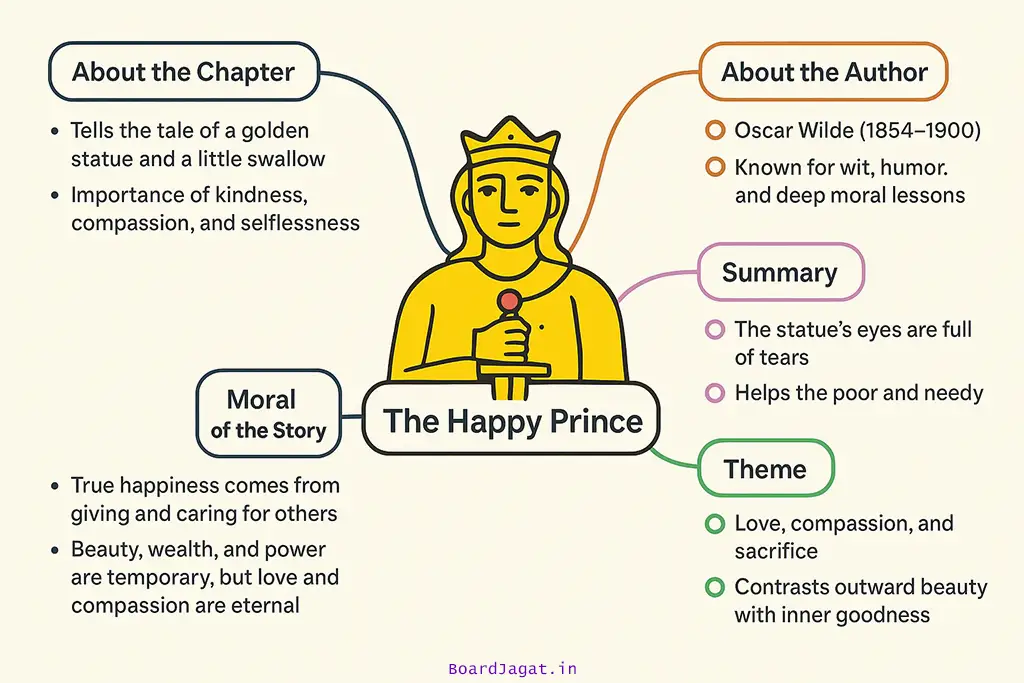
Today, in this blog post ‘The Happy Prince Summary Class 9 English’, we’ll read short & detailed summary of the chapter The Happy Prince by A.K. Ramanujan from Class 9th NCERT English Moments(supplementary) Chapter 5 that will help you to understand this chapter better so that you can score best in your exam.
The Happy Prince About the Chapter
The Happy Prince is a short story written by Oscar Wilde. It tells the tale of a golden statue of a prince and a little swallow. The statue, once a real prince, now stands high above the city and sees all the sorrow and misery of the people. With the help of a kind-hearted swallow, the Happy Prince gives away all his gold and jewels to help the poor and needy. The story beautifully shows the importance of kindness, compassion, and selflessness.
The Happy Prince About the Author
Oscar Wilde (1854–1900) was a famous Irish writer, poet, and playwright known for his wit, humor, and deep moral lessons. Some of his well-known works include The Picture of Dorian Gray, The Selfish Giant, and The Importance of Being Earnest. Wilde’s stories often teach about love, generosity, and the true value of human feelings over material wealth.
Short Summary of The Happy Prince
The story begins with a statue of the Happy Prince standing high above the city. The statue is decorated with gold and precious stones. One night, a swallow takes shelter at the statue’s feet and discovers that the Prince’s eyes are full of tears. The Prince, who had never seen sorrow while he was alive, now sees the suffering of the poor from his high place and feels deep pity.
He requests the swallow to help him by taking the ruby, sapphires, and gold leaves from his body and giving them to the poor and needy. The swallow obeys and delivers the Prince’s treasures to a poor seamstress, a struggling playwright, and a matchgirl.
As the swallow continues to help the Prince, it grows cold and weak. Eventually, the bird dies at the Prince’s feet. The Prince’s leaden heart breaks in sorrow. Later, the statue is melted down, but the heart and the dead swallow are found together. God declares them the two most precious things in the city and takes them to Heaven.
The Happy Prince Summary
High above the city stood a magnificent statue of the Happy Prince, gilded with fine gold and adorned with precious jewels. His eyes were made of bright blue sapphires, and a large red ruby sparkled on the hilt of his sword. People admired the statue for its beauty, but they did not realize that the Happy Prince’s heart was full of sorrow.
The Prince’s Sadness:
When the Prince was alive, he lived a life of luxury in his palace where sadness was not allowed to enter. Everyone called him the Happy Prince because he was always cheerful and knew nothing of pain or suffering. But after his death, his statue was placed high above the city, and from that height, he could see all the ugliness and misery of human life. His heart, made of lead, was now filled with compassion and grief for the poor people he could see everywhere.
The Little Swallow’s Arrival:
One night, a little swallow flew over the city. His friends had already gone to Egypt for the winter, but he had stayed behind for a while. Looking for a place to rest, he decided to sleep at the feet of the Happy Prince’s statue. As he was about to sleep, he felt drops of water falling on him. Surprised, he looked up and found that the Happy Prince was weeping. The bird asked him why he was crying.
Helping the Poor Seamstress:
The Happy Prince told the swallow that far away, in a poor house, lived a seamstress whose hands were rough and red from sewing clothes for the rich. Her little boy was ill and crying for oranges, but she could only give him river water. The Prince requested the swallow to take the ruby from his sword and give it to her. At first, the swallow refused because he had to go to Egypt, but seeing the Prince’s sadness, he agreed. The swallow flew to the woman’s house, placed the ruby beside her, and fanned the sick boy’s forehead with his wings. When he returned, he felt warm even though it was cold — the warmth of doing a good deed.
Helping the Playwright:
The next night, the Happy Prince saw a young playwright sitting in a cold attic. He was hungry and too cold to finish his play. The Prince had no ruby left, so he asked the swallow to take out one of his sapphire eyes and give it to the man. The swallow hesitated but obeyed. The playwright was delighted with the gift and could now finish his play.
Helping the Match Girl:
The following night, the Prince saw a poor little match girl crying in the street because her matches had fallen and were spoiled. If she didn’t bring home money, her father would beat her. The Prince asked the swallow to pluck out his other sapphire eye and give it to her. The swallow was heartbroken to make the Prince blind, but he obeyed. The girl went home happily, not knowing the true value of what she held.
The Swallow’s Loyalty:
Now that the Happy Prince was blind, the swallow decided not to leave him. He stayed with the Prince forever. The bird told him stories of distant lands, and the Prince asked him to fly over the city and describe what he saw. The swallow saw the contrast between the rich living in luxury and the poor suffering in misery. The Prince told the swallow to strip off the gold leaves from his body and give them to the poor. The children’s faces became brighter, and they laughed and played again.
The Swallow’s Death and the Prince’s Broken Heart:
Winter came, and it grew bitterly cold. The little swallow became weaker day by day, but he refused to leave the Prince. Finally, realizing that he was going to die, the swallow flew up to the Prince’s shoulder, kissed him on the lips, and fell dead at his feet. At that very moment, the Happy Prince’s leaden heart broke into two pieces — a symbol of his deep sorrow and love.
The City’s Reaction:
The next morning, the Mayor and the Town Councillors saw the shabby statue. The Prince was no longer golden, his jewels were gone, and a dead bird lay at his feet. They decided to pull down the statue because it looked ugly. The statue was melted in a furnace, but the leaden heart did not melt. It was thrown onto a dust heap where the dead swallow also lay.
God’s Judgment:
Finally, God asked one of His Angels to bring Him the two most precious things in the city. The Angel brought the broken lead heart and the dead bird. God said that the Angel had chosen rightly, for in His paradise the little bird would sing forever, and the Happy Prince would live in the city of gold and praise God forever.
Conclusion:
Through this touching story, Oscar Wilde teaches that real beauty lies in love, kindness, and sacrifice. The Happy Prince and the Swallow both showed true compassion by giving everything they had for the happiness of others. Their selfless actions make them immortal in the eyes of God and humanity.
View: all Chapter Summary of Class 9th English
The Happy Prince Theme of the Story
The main theme of The Happy Prince is love, compassion, and sacrifice. The story shows that real happiness lies in helping others. It also contrasts outward beauty with inner goodness—the Prince’s statue loses its golden charm, but his soul becomes truly beautiful through his generosity. The story teaches that love and kindness make the world a better place.
The Happy Prince Moral of the Story
The moral of The Happy Prince is that true happiness comes from giving and caring for others. Beauty, wealth, and power are temporary, but love and compassion are eternal. Both the Prince and the Swallow teach us that selfless service and sacrifice are the highest virtues in life.