Today, in this blog post ‘Iswaran the Storyteller Summary Class 9 English’, we’ll read short & detailed summary of the chapter Iswaran the Storyteller by R.K. Laxman from Class 9th NCERT English Moments(supplementary) Chapter 3 that will help you to understand this chapter better so that you can score best in your exam.
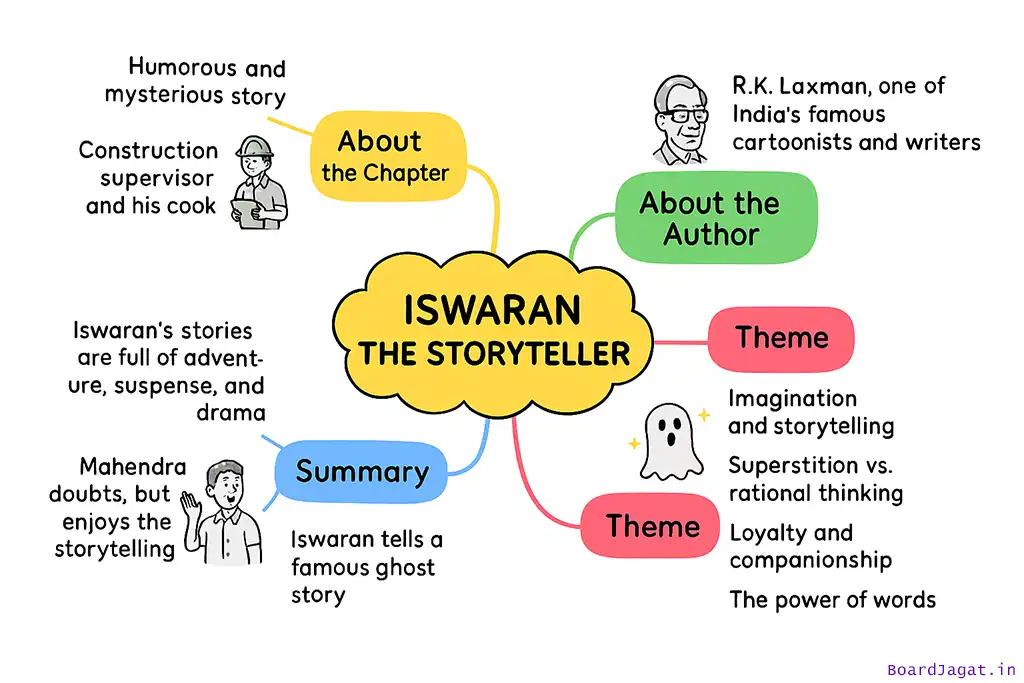
Iswaran the Storyteller About the Chapter
“Iswaran the Storyteller” is a humorous and slightly mysterious story written by R.K. Laxman. It revolves around Mahendra, a simple man who supervises construction sites, and his cook, Iswaran, who has a talent for telling fascinating stories full of adventure, suspense, and drama. Through Iswaran’s imaginative storytelling, the author shows how even ordinary events can become exciting when told creatively.
Iswaran the Storyteller About the Author
R.K. Laxman (Rasipuram Krishnaswamy Laxman) was one of India’s most famous cartoonists and writers. He is best known for his cartoon series “The Common Man”, which appeared in The Times of India for several decades. Laxman had a sharp sense of humour and often used it to comment on the life of ordinary Indians. His writing, like his cartoons, combined wit, realism, and gentle satire.
Short Summary of Iswaran the Storyteller
Mahendra, a bachelor and junior supervisor, moves from one construction site to another because of his job. His loyal cook, Iswaran, accompanies him everywhere. Iswaran is an excellent cook and housekeeper, but his most remarkable talent is storytelling. He narrates stories with such dramatic expressions and suspense that Mahendra listens spellbound.
One of Iswaran’s famous stories is about a mad elephant that he claims to have tamed single-handedly with a blow to its toenail! Though Mahendra doubts its truth, he enjoys the way Iswaran tells it.
One night, Iswaran tells him about a female ghost who haunts the nearby burial ground. Mahendra laughs it off, but later, on a full moon night, he sees a dark, ghostly figure outside his window. Terrified, he convinces himself it was just his imagination. But the next morning, when Iswaran mentions that he too heard the ghost moaning, Mahendra gets so scared that he decides to leave the place immediately.
Iswaran the Storyteller Summary (Detailed)
The story “Iswaran the Storyteller” is narrated by a man named Ganesh, who tells us about his friend Mahendra. Mahendra was a junior supervisor in a firm that hired out supervisors to different construction sites such as factories, bridges, dams, and chemical plants. His work required him to frequently shift from one place to another.
Despite these transfers, Mahendra managed well because he was a simple, bachelor man with few needs. He could live comfortably in temporary shelters or tents. His biggest asset, however, was his cook and caretaker, Iswaran, who accompanied him everywhere without complaint.
Iswaran’s Character and Daily Routine:
Iswaran was a devoted and resourceful servant. He could find ingredients even in the most barren places and cook delicious meals from almost nothing. His daily routine was simple; after Mahendra left for work, Iswaran would clean the place, wash clothes, take a long bath, and then spend some time reading Tamil thrillers.
These Tamil novels influenced him deeply. He had a dramatic and imaginative mind and would narrate even ordinary incidents with suspense, action, and flair; much like a professional storyteller. Mahendra loved listening to him and never got bored.
The Story of the Mad Elephant:
One of Iswaran’s most fascinating tales was about a mad elephant. According to him, a tusker once escaped from a timber yard and went on a rampage, destroying huts, fences, stalls, and even entering a school ground. Everyone ran in fear, but young Iswaran, with great courage, faced the elephant alone.
He claimed that he took a cane stick and struck the elephant’s third toenail, which made the animal collapse instantly! When Mahendra asked how he did it, Iswaran said it was a Japanese martial art called karate or ju-jitsu that he had read about somewhere.
Mahendra doubted the truth of the story but was always entertained by Iswaran’s exciting narration.
The Ghost Story:
One day, on a traditional festival when people offer food to ancestors, Iswaran prepared a grand meal. After dinner, he began talking about supernatural happenings in the area. He told Mahendra that the place they were living in used to be a burial ground, and sometimes, especially on full moon nights, a female ghost carrying a foetus appeared.
He described the ghost so vividly with matted hair, a shrivelled face, and skeleton-like arms that Mahendra became frightened. Though he scolded Iswaran for believing in ghosts, the description stayed in his mind.
Mahendra’s Frightening Experience:
After that night, Mahendra could not sleep peacefully. He began to feel uneasy at night and often avoided looking out of the window during full moons.
One night, he was woken by a low moaning sound near his window. At first, he thought it was a cat, but soon the sound became louder and more human-like. When he finally gathered courage to look, he saw a dark, shadowy figure holding a bundle in its arms. Terrified, he fell back on his bed, sweating in fear.
Later, he tried to convince himself that it was just his imagination or a dream. But the next morning, when Iswaran mentioned that he had heard the ghost’s moaning from Mahendra’s room, all his doubts vanished.
Overcome by fear, Mahendra decided to resign from his job and leave the place immediately.
Conclusion:
The story ends humorously, showing how the imaginative power of Iswaran’s storytelling deeply affected Mahendra’s rational mind. Even though Mahendra did not believe in ghosts, his subconscious fear got the better of him.
Iswaran, with his dramatic storytelling, brings life and colour into an otherwise dull and lonely existence. The story thus celebrates imagination, humour, and the art of storytelling while showing how even a rational man can be influenced by fear.
In Short:
- Mahendra = A simple supervisor
- Iswaran = His loyal cook and storyteller
- Elephant story = Shows Iswaran’s imagination
- Ghost story = Shows his power to influence
- Mahendra’s fear = Proves the effect of imagination on reality
View: all Chapter Summary of Class 9th English
Iswaran the Storyteller Theme
The story explores themes of:
- Imagination and storytelling – how creativity can turn ordinary life into something fascinating.
- Superstition vs. rational thinking – showing how even educated people can fall prey to fear and imagination.
- Loyalty and companionship – through the bond between Mahendra and Iswaran.
- The power of words – how storytelling can influence emotions and even alter perception of reality.
Iswaran the Storyteller Moral of the Story
The story teaches that:
- Imagination is powerful and can influence our thoughts and feelings.
- We should not blindly believe in superstitions or ghost stories without reason.
- A good storyteller can make even simple things seem extraordinary.
- Our fears often come from within our own minds, not from the outside world.
Read Also: Iswaran the Storyteller Class 9 ncert question answer