Today, in this blog post ‘In the Kingdom of Fools Summary Class 9 English’, we’ll read short & detailed summary of the chapter In the Kingdom of Fools by A.K. Ramanujan from Class 9th NCERT English Moments(supplementary) Chapter 4 that will help you to understand this chapter better so that you can score best in your exam.
In the Kingdom of Fools About the Chapter
“In the Kingdom of Fools” is a folktale from A.K. Ramanujan’s Folk Tales from India. The story highlights how foolish rulers can endanger their people and how wisdom and intelligence can save lives. It describes a kingdom where night is turned into day and everything costs the same, showing the absurdity of blind rule and senseless laws.
In the Kingdom of Fools About the Author
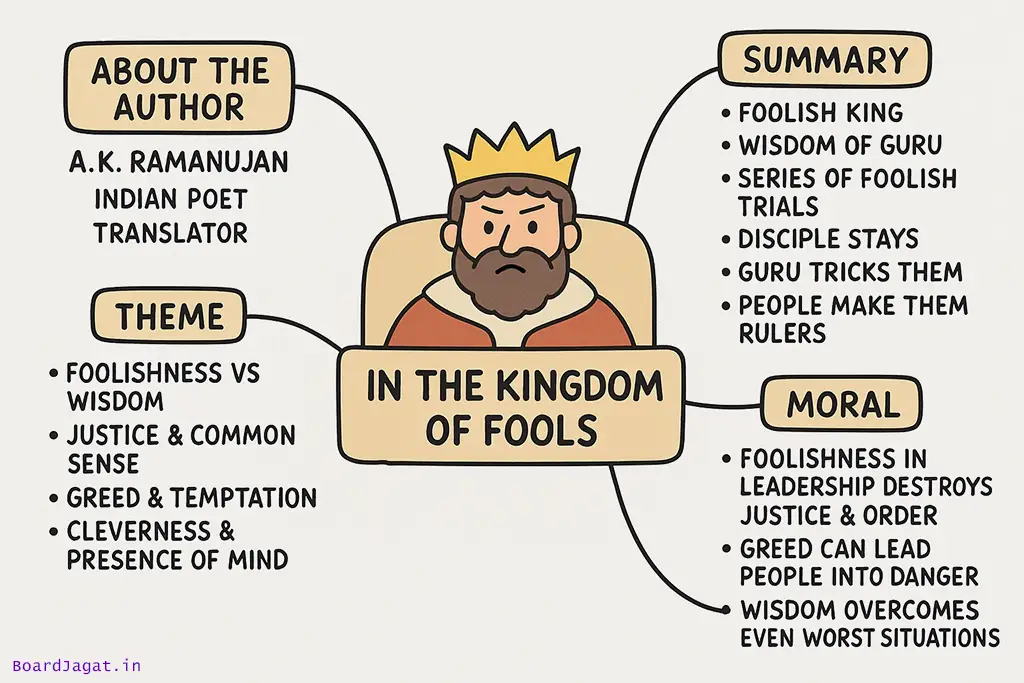
A.K. Ramanujan (1929–1993) was an Indian poet, scholar, and translator. He wrote in both English and Kannada and is known for bringing Indian folktales and culture to a wider audience. His famous works include The Striders, Relations, and Folk Tales from India. Ramanujan’s storytelling blends simplicity, humour, and deep moral insight.
Short Summary of In the Kingdom of Fools
The story begins in a strange kingdom ruled by a foolish king and his equally foolish minister. They order that people must work at night and sleep during the day, and that everything should cost one duddu. A wise guru and his disciple visit the kingdom and are surprised by its odd customs. The guru warns his disciple to leave, but the disciple stays because food is cheap.
Later, a series of foolish trials take place when a thief dies after a wall collapses on him. The king and minister absurdly blame different people: the merchant, the bricklayer, the dancing girl, and finally the goldsmith, until justice circles back to the original merchant. When the merchant is found too thin to be executed, the fat disciple is chosen to die instead.
The guru returns using his powers, and through cleverness, he tricks the king and minister into dying on the stake themselves. The people then make the guru and disciple the new rulers, who wisely restore order in the kingdom.
In the Kingdom of Fools Summary
The story “In the Kingdom of Fools” is a folktale from southern India, retold by A.K. Ramanujan. It is a humorous yet meaningful story that shows how foolish people in power can create chaos and how wisdom and presence of mind can save lives.
Once there was a kingdom ruled by a foolish king and his equally foolish minister. They wanted to be different from other rulers, so they decided to change day into night and night into day. They ordered that everyone must work at night and sleep during the day. Anyone who disobeyed would be punished with death.
The people, afraid of death, obeyed the order. The whole kingdom became strange during the day, the streets were empty, and at night the city came alive.
One day, a guru and his disciple arrived in the kingdom. They were surprised to see that everyone was asleep in daylight and that even animals had learned to sleep during the day. In the evening, when the people woke up, they went to buy food and found that everything cost the same price, one duddu (a small coin), whether it was rice, wheat, or bananas. The disciple was delighted because food was so cheap, but the guru realized that this was a kingdom of fools and warned his disciple to leave.
However, the disciple refused. He loved the cheap food and decided to stay. The guru left alone, saying, “This is no place for us. You never know what these fools might do next.”
The disciple stayed on happily, eating and growing fat. One day, a thief broke into a merchant’s house to steal, but the wall collapsed and killed him. The thief’s brother went to the foolish king to seek justice, saying that the merchant was responsible because he built a weak wall. The king promised justice and called the merchant to court.
The merchant said the wall was built in his father’s time and that the bricklayer who built it should be punished. The king then called the bricklayer, who said that while he was building the wall, a dancing girl distracted him with her jingling anklets, which made him build a bad wall. The king then called the dancing girl.
The dancing girl, now an old woman, said she had been walking up and down because the goldsmith had delayed making her jewellry. The goldsmith was called, and he said he was busy with an urgent order from a rich merchant for a wedding. Ironically, the rich merchant was the same man whose house the thief had broken into. The king declared that the merchant’s father was the real culprit, but since he was dead, the merchant must die in his place because he had inherited both his wealth and his sins.
A new stake was ordered for the execution. But when the king’s servants prepared it, they found the merchant was too thin to fit properly. The king then decided to find a fat man for the stake. Unfortunately, they found the disciple, who had become very fat after eating cheap food for months. He was caught and sentenced to death.
The disciple remembered his guru’s warning and prayed to him for help. The guru, who had spiritual powers, saw everything in a vision and came to rescue his disciple.
The guru went to the king and cleverly created confusion. He asked to be executed before his disciple, saying there was a great mystery behind the stake. The king, curious, asked why. The guru whispered that whoever dies on the new stake first will be reborn as the king of this country, and whoever dies second will be reborn as the minister.
The foolish king and his minister, greedy for power even in the next life, decided to die on the stake themselves. That night, they disguised themselves as the guru and disciple and were executed.
When the people saw the bodies of their king and minister the next morning, they panicked and mourned. They had no ruler now, so they begged the guru and disciple to become their new king and minister. The guru accepted only on one condition that all the old foolish laws must be changed.
From that day, night became night and day became day, prices became normal, and the kingdom began to run wisely and peacefully.
The story ends with the victory of wisdom over foolishness. It teaches that greed and stupidity lead to destruction, while intelligence, patience, and good sense can save lives and bring peace.
View: all Chapter Summary of Class 9th English
In the Kingdom of Fools Theme
The main themes of the story are:
- Foolishness vs. Wisdom: The story contrasts the foolish behaviour of the king and minister with the wisdom of the guru.
- Justice and Common Sense: It shows how justice can go wrong under foolish rulers.
- Greed and Temptation: The disciple’s greed for cheap food almost leads to his death.
- Cleverness and Presence of Mind: The guru’s intelligence and calm thinking save both their lives.
In the Kingdom of Fools Moral of the Story
- Foolishness in leadership can destroy justice and order.
- Greed can lead people into danger.
- Wisdom, intelligence, and presence of mind can overcome even the worst situations.
- We should always listen to wise advice and think before making decisions.
Read Also: In the Kingdom of Fools Class 9 ncert question answer