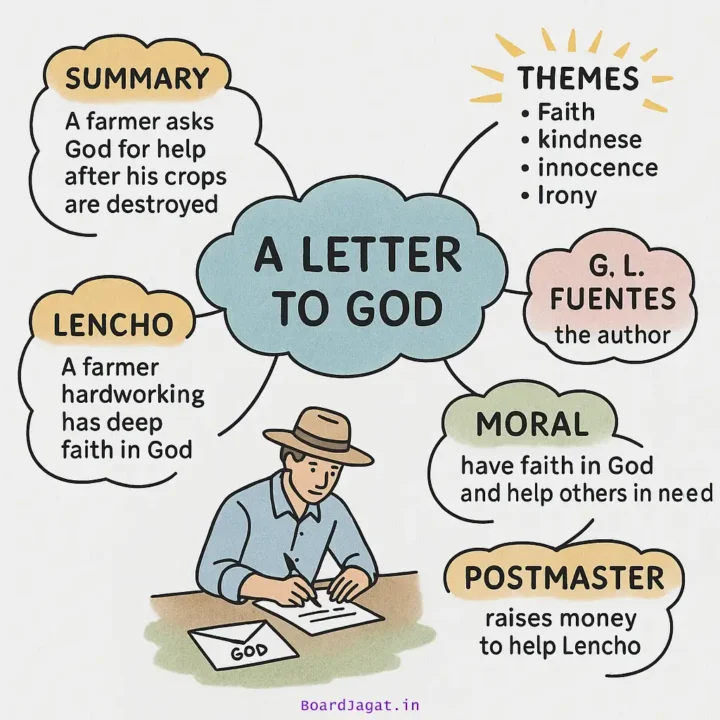
Today, in this post ‘A Letter to God Summary Class 10 English’, we will study the very first chapter of class 10th English first flight prose that is A Letter to God written by G.L. Fuentes. We’ll study all important topics of the chapter like theme, summary, central idea, and the moral of the story, etc, one by one. Students, this chapter is the most important chapter from the exam point of view, so read it carefully to score better in your board exam.
A Letter to God About the Chapter
“A Letter to God” is the opening chapter of the Class 10 English NCERT book First Flight. It tells the story of Lencho, a simple farmer whose crops are destroyed by a hailstorm. Having unshakable faith in God, he writes a letter asking for money to survive. The postmaster and his employees secretly collect money to help him. However, Lencho misunderstands their kindness and believes that the post office employees have stolen part of God’s money. This story beautifully shows innocence, faith, human kindness, and irony.
About the Author – G.L. Fuentes
G.L. Fuentes (Gregorio López y Fuentes) was a Mexican novelist, journalist, and teacher. He is known for writing simple yet powerful stories based on rural life, farmers, and social realities of Mexico. His writings focus on themes such as poverty, faith, human struggle, and the harshness of nature. “A Letter to God” is one of his most famous short stories included in school literature worldwide.
Short Summary of A Letter to God
“A Letter to God” is about a farmer named Lencho whose crops are destroyed by a hailstorm. Having great faith in God, he writes a letter asking for 100 pesos to re-sow his fields. The postmaster and his employees feel moved by his faith and collect money to help him. They send him 70 pesos, but Lencho believes God cannot make a mistake, so he thinks the post office employees stole the rest. He writes another letter asking God to send the remaining money through some other way. The story shows innocence, faith, kindness, and irony.
A Letter to God Summary
The story begins in a valley where a hardworking farmer named Lencho lives with his family. Their small house stands on the top of a low hill, and from there the entire valley and its fields can be seen clearly. Lencho depends completely on the success of his crops for survival. His corn crop is ripe, and he eagerly looks at the sky, hoping for the rain that is essential for a good harvest.
Very soon, dark clouds gather in the north-east, and Lencho joyfully tells his family that rain is coming. In the story, the large raindrops that fall are described as “new silver coins,” showing that to Lencho, rain means wealth, prosperity, and food. However, Lencho’s happiness does not last long. The rain suddenly turns into a severe hailstorm. The hailstones are compared to “frozen pearls,” and they beat down the entire field for an hour.
When the storm stops, Lencho’s heart is filled with sadness. The crop is completely destroyed, “Not a leaf remained.” The family is devastated because they have no food left for the year. Lencho tells his sons that they will go hungry and describes the storm as a plague of locusts that have destroyed everything.
Despite this tragedy, Lencho does not lose hope. His faith in God is so strong that he is certain God will help him. His faith was firm and unquestioning. Lencho decides to write a letter to God, asking Him for 100 pesos so that he can sow his fields again and support his family.
He goes to the post office to mail the letter. The postman, surprised to find a letter addressed “To God,” takes it to the postmaster. At first, the post office staff laugh, but the postmaster is moved by Lencho’s sincerity and says that he wishes he had such great faith. To preserve Lencho’s belief in God, he decides to answer the letter.
The postmaster collects money from his employees and also contributes part of his salary. Even after all efforts, they can collect only 70 pesos, not the 100 that Lencho had asked for. Still, they put the money into an envelope and signed it as “God.”
When Lencho comes to the post office the following Sunday, he calmly asks if there is a letter for him. Seeing the money, he doesn’t show the slightest surprise. This shows how completely he trusts God’s response. But when he counts the money, he becomes angry. He is sure that God would never make a mistake, so the only explanation he believes is that the post office employees must have stolen the remaining amount.
He immediately writes another letter to God, asking Him to send the remaining money, but not through the post office, which he calls “a bunch of crooks”. This creates a strong sense of dramatic irony; the same people he calls thieves are the ones who helped him most.
The story ends humorously but thoughtfully, showing the innocent faith of Lencho, the kindness of the postmaster, and the misunderstandings that arise from blind belief.
Read Also: A Letter to God Question Answer
A Letter to God Themes
The story shows the theme of faith in God, as Lencho believes God will help him after the storm. It also highlights human kindness, shown by the postmaster and his staff who collect money for Lencho. Another theme is irony, because Lencho thinks the helpers are thieves. The story also reflects man’s helplessness before nature, when the hailstorm destroys the crop.
A Letter to God Central Idea
The story highlights how strong faith can inspire hope, but also how innocence can lead to misunderstanding. It also shows that good deeds do not always get recognised, yet helping others is still worthwhile. The story combines humour and irony to show the contrast between divine faith and human effort.
A Letter to God Moral of the Story
The moral of the story is that we should have faith, but also trust the goodness of people. It teaches that kindness should be done selflessly, without expecting anything in return. The story also reminds us that we must stay hopeful even in difficult times.