Today, in this blog post ‘The Lost Child Summary Class 9 English’, we’ll read short & detailed summary of the chapter The Lost Child by Mulk Raj Anand from Class 9th English Moments Chapter 1 that will help you to understand this chapter better so that you can score best in your exam.
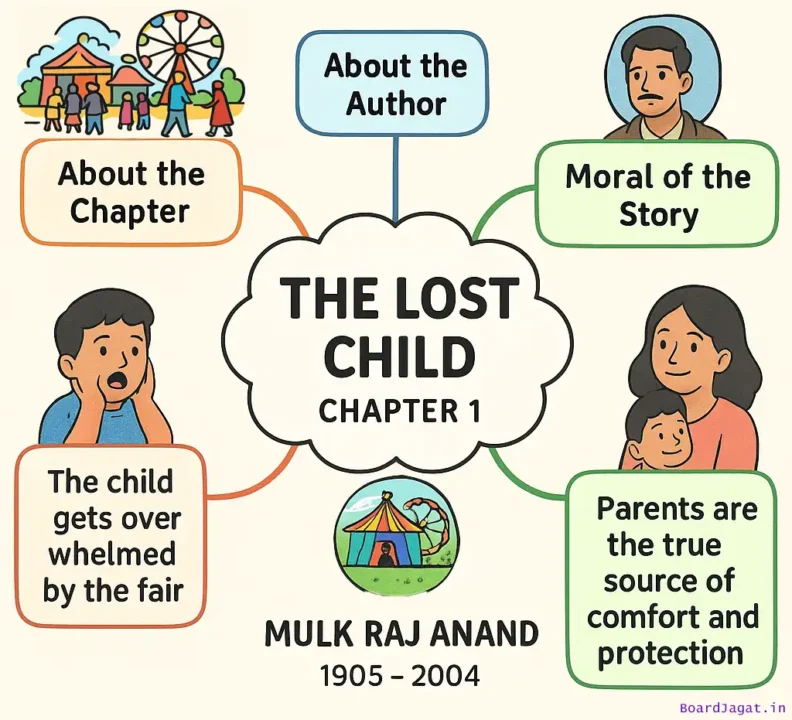
The Lost Child About the Chapter
“The Lost Child” is the first chapter in the Moments supplementary reader of Class 9 English (NCERT).
It beautifully captures a child’s innocence and the deep bond between parents and their child. The story describes how a little boy, visiting a fair with his parents, gets attracted by different things like sweets, toys, garlands, and balloons, but later realises that nothing in the world can replace the love and safety of his parents.
The Lost Child About the Author
Mulk Raj Anand (1905 – 2004) was one of the pioneers of Indian English literature. He wrote novels, short stories, and essays that dealt with social issues such as poverty, injustice, and the lives of the poor and marginalised. His famous works include Untouchable, Coolie, and The Big Heart. Anand’s writing is known for its humanistic themes and realistic portrayal of ordinary people.
Short Summary of The Lost Child
The story takes place during a spring fair. A small boy goes to the fair with his parents. Along the way, he gets fascinated by toys, sweets, and colourful balloons. Every time he expresses his wish to buy something, he knows his parents will refuse, so he moves on quietly.
When they reach the fair, the boy becomes completely absorbed in its sights and sounds. But while looking at the roundabout, he suddenly realises that his parents are no longer with him. Terrified, he begins to cry loudly and runs here and there in search of them.
A kind man finds the child and tries to comfort him by offering sweets, balloons, and rides. But the boy refuses everything and keeps crying, “I want my mother, I want my father.” This shows that all his desires vanish when he feels unsafe and alone.
The Lost Child Summary Class 9 English
The story “The Lost Child” is a touching tale about a little boy’s journey from innocent desires to the realization of what truly matters, the love and presence of his parents.
The story begins with the description of a spring festival. People from nearby villages are heading toward the fair in a cheerful mood. Men, women, and children, dressed in colourful clothes, walk through the fields and narrow lanes. Among them is a young boy, full of excitement and curiosity, going to the fair with his father and mother.
As they walk, the boy gets attracted by everything he sees on the way. First, he stops to look at toys displayed in a shop and wishes to have one. However, knowing his father’s usual strictness, he quietly moves on without insisting. His mother lovingly tries to divert his attention by showing him the beautiful mustard field, golden with blooming flowers. The boy runs after butterflies and dragonflies in the field, enjoying their vibrant colours.
Soon, they reach the fair. The child’s eyes sparkle as he sees all the fascinating things around him, like the sweetmeat seller selling gulab jamun, rasgulla, burfi, and jalebi; the flower seller with garlands of gulmohar; the balloon seller with bright balloons; and even a snake-charmer playing his flute. Every time the child wishes for something, he restrains himself because he knows his parents will refuse, calling him either greedy or too old for toys.
As they move further, the boy sees a roundabout (merry-go-round) and finally gathers courage to ask, “I want to go on the roundabout, please, Father, Mother.” But this time, there is no response. When he turns around, he realises his parents are not there.
A wave of panic and fear sweeps over him. The child runs around frantically, shouting “Mother! Father!” His eyes fill with tears, his face turns red, and his clothes become dirty as he rushes through the crowd, desperately searching for his parents.
In his panic, he reaches a temple, where a huge crowd has gathered. People push and shove, and the child is almost trampled underfoot. Fortunately, a kind man notices him, lifts him in his arms, and asks who he is and where he lives. But the poor child can only cry, “I want my mother, I want my father.”
The man tries to comfort the boy by offering him everything he had wanted earlier, like a ride on the roundabout, the balloons, the garland, and sweets. But now, the child refuses everything. He is no longer interested in toys or sweets. His only wish is to be reunited with his parents.
View: all Chapter Summary of Class 9th English
The Lost Child Theme
The main theme of “The Lost Child” is the deep love and emotional bond between parents and their child, and how that bond is far more valuable than any worldly desire. At the beginning of the story, the child is fascinated by the fair. His mind is full of curiosity and excitement. But when he gets separated from his parents, all his interests disappear, and his only wish is to find them. Through this sudden change, Mulk Raj Anand beautifully shows the difference between temporary attraction and true affection. The story highlights that a child’s greatest need is not material pleasure but the love, care, and security of his parents. It also reflects the innocence of childhood and the realization that family is the greatest treasure in life.
The Lost Child Moral of the Story
The story teaches that parents are the true source of comfort, protection, and happiness for a child. Material things like toys or sweets may attract us for a moment, but the love of family is priceless. It also reminds us to be careful and stay close to our elders in crowded places.
Conclusion:
“The Lost Child” is a simple yet powerful story that beautifully captures a child’s innocence and emotional bond with his parents. It shows that the love and security of parents are far more valuable than all the material pleasures of the world.
Read Also: The Lost Child NCERT Questions Answer