Today, in this post, ‘My Childhood Summary Class 9 English’, we’ll read the short and detailed summary of Class 9th NCERT English Beehive chapter 6, My Childhood by Dr. APJ Abdul Kalam.
My Childhood About the Lesson
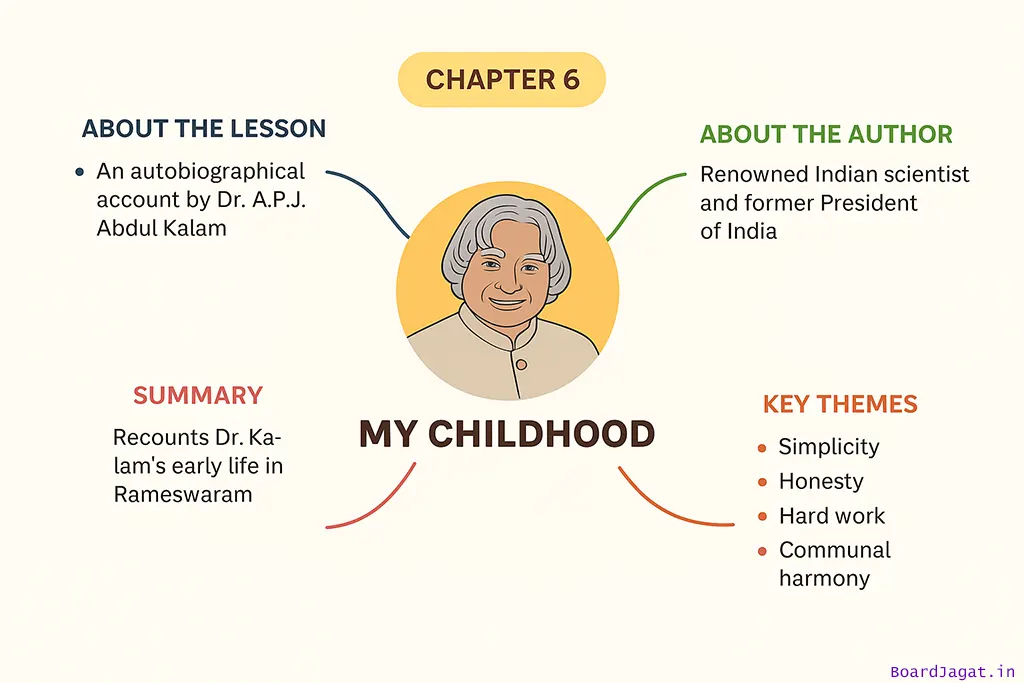
The lesson My Childhood is an autobiographical account by Dr. A.P.J. Abdul Kalam, where he recalls his early life, family, friends, and the lessons he learned while growing up in Rameswaram. The chapter highlights values such as simplicity, honesty, hard work, communal harmony, and tolerance. It also shows how his upbringing shaped his personality and inspired him to achieve great heights in life.
My Childhood About the Author
Dr. Avul Pakir Jainulabdeen Abdul Kalam (1931–2015) was a renowned Indian scientist, aerospace engineer, and the 11th President of India (2002–2007). Popularly known as the “Missile Man of India,” he played a key role in India’s missile and nuclear programs. Apart from being a scientist, he was deeply admired as a teacher, writer, and motivator. His life remains an inspiration for students and youth across the country.
Short Summary of My Childhood Class 9
My Childhood is an autobiographical piece by Dr. A.P.J. Abdul Kalam, describing his early life in Rameswaram. Born into a humble but respected family, Kalam learned values of honesty, simplicity, and kindness from his parents. He experienced communal harmony through his friendships with Hindu boys and support from teachers like Sivasubramania Iyer, who encouraged him to dream big. He also witnessed social discrimination when a teacher objected to his sitting with a Hindu friend. From his father, he imbibed lessons of faith, humility, and spiritual strength. The chapter highlights how his upbringing shaped his personality and laid the foundation for his later achievements.
My Childhood Summary
The chapter My Childhood is an autobiographical excerpt written by Dr. A.P.J. Abdul Kalam. He recalls his childhood days in Rameswaram, Tamil Nadu, where he was born in a simple but respected middle-class Muslim family. His father, Jainulabdeen, was a man of deep integrity, wisdom, and generosity, while his mother, Ashiamma, was caring and hospitable. Although the family was not wealthy, they lived with dignity and provided a secure upbringing for their children.
Kalam describes how his early life was shaped by the values of simplicity, honesty, and hard work. He grew up in an environment of communal harmony. His close friends were from Hindu families, and religious differences never affected their bond. His family also had strong ties with their Hindu neighbours. His father believed in living a life of service and spiritual strength rather than material wealth.
Several incidents left lasting impressions on Kalam. One was when a new teacher objected to him, a Muslim boy, sitting next to his Hindu friend. This hurt him, but it also taught him about social prejudice. Another incident was when his science teacher, Sivasubramania Iyer, encouraged him to aim high and pursue education beyond the small town. His teacher even invited Kalam to his home, breaking social barriers of caste and religion.
From his father, Kalam learned that prayers and spiritual strength give true peace. His father advised him that every human being is part of a larger universe and must accept their destiny with faith. These teachings, combined with the guidance of his teachers, deeply influenced Kalam’s outlook and character.
Thus, the chapter beautifully portrays how his modest childhood, combined with strong family values, religious tolerance, and inspiring teachers, shaped Dr. Kalam into a visionary scientist and one of India’s most respected leaders.
My Childhood Point-Wise Summary
The lesson My Childhood is an extract from the autobiography of Dr. A.P.J. Abdul Kalam, where he shares memories of his early life in the small island town of Rameswaram, Tamil Nadu.
Early Life and Family Background
- Dr. Kalam was born in 1931 into a middle-class Muslim family.
- His father, Jainulabdeen, was neither formally educated nor wealthy, but he was wise, honest, and generous. He lived a simple life and never accumulated wealth.
- His mother, Ashiamma, was a kind-hearted and caring woman who supported the family and fed many outsiders daily.
- Kalam inherited honesty and self-discipline from his father, and faith and kindness from his mother.
- Though not rich, his childhood was safe and full of affection.
Simple Childhood and Work Experience
- Kalam grew up in a large ancestral house built in the 19th century.
- During World War II, when demand for tamarind seeds increased, he collected and sold them to earn a small amount of money.
- Later, he also delivered newspapers to support his family financially.
- These experiences taught him the value of hard work and self-reliance at an early age.
Communal Harmony and Friendship
- Kalam had close Hindu friends, such as Ramanadha Sastry, Aravindan, and Sivaprakasan.
- Their families, despite belonging to different religions, lived in harmony and respected each other’s beliefs.
- His father often discussed spiritual matters with his close friend, the priest of Rameswaram temple.
- This environment of tolerance and unity left a deep impact on Kalam’s thinking.
Experiences with Teachers
- A turning point came when a new teacher objected to Kalam sitting with his Hindu friend Ramanadha Sastry, saying that a Muslim boy should not sit next to a high-caste Hindu priest’s son.
- This deeply upset both boys, but Ramanadha Sastry’s father, the temple priest, rebuked the teacher for spreading social inequality.
- Another teacher, Sivasubramania Iyer, encouraged Kalam to develop scientific curiosity and dream big.
- However, even this teacher’s conservative wife initially refused to serve food to a Muslim boy, though later she overcame her prejudice.
Values and Lessons Learned
- From these experiences, Kalam learned that religion should never divide people.
- He realised the power of positive influence from parents, teachers, and role models.
- His father taught him the importance of living a simple, spiritual, and righteous life.
- His teachers motivated him to work hard, aim high, and believe in equality.
Essence of the Chapter
The chapter My Childhood shows how Dr. Kalam’s early life was shaped by simplicity, communal harmony, discipline, and encouragement from his parents and teachers. These values became the foundation of his extraordinary achievements as a scientist and as the “People’s President” of India.
Read Also: My Childhood NCERT Solutions
View all Chapter: Class 9th English Solutions