In this post, ‘A Letter to God Question Answer Class 10 English’, we’ll read NCERT Solutions for A Letter to God Class 10th English First Flight Chapter 1. Below are simple, exam-ready answers to each Thinking About Text & Thinking About Language question. All questions are based directly on the latest NCERT Textbook. I’ve kept them precise so you can directly write these in your exam to score the best. You can also read the Summary of A Letter to God to understand these questions better.
Oral Comprehension Check Question Answer
Q1. What did Lencho hope for?
Ans. Lencho hoped for rain so that his crops would grow well.
Q2. Why did Lencho say the raindrops were like ‘new coins’?
Ans. Lencho compared raindrops to new coins because rain meant a good harvest and prosperity for him.
Q3. How did the rain change? What happened to Lencho’s fields?
Ans. The rain changed into a hailstorm, and the hailstones destroyed Lencho’s entire crop.
Q4. What were Lencho’s feelings when the hail stopped?
Ans. Lencho felt sad and hopeless because his crops were completely ruined.
Q5. Who or what did Lencho have faith in? What did he do?
Ans. Lencho had complete faith in God. He wrote a letter to God asking for money to help his family.
Q6. Who read the letter?
Ans. The postmaster read Lencho’s letter.
Q7. What did the postmaster do then?
Ans. The postmaster collected money from his employees and sent it to Lencho.
Q8. Was Lencho surprised to find a letter for him with money in it?
Ans. No, Lencho was not surprised, because he was sure that God would help him.
Q9. What made him angry?
Ans. Lencho became angry when he found that the money was less than what he had asked for.
A Letter to God Thinking about the Text
Q1. Who does Lencho have complete faith in? Which sentences tell you this?
Ans. Lencho has complete faith in God. This is shown when the story says that Lencho had “firm faith in God” and that he believed God would help him in his trouble. He writes a letter directly to God asking for money.
Q2. Why does the postmaster send money to Lencho? Why does he sign the letter ‘God’?
Ans. The postmaster sends money to Lencho because he is moved by Lencho’s strong faith in God and wants to help him. He signs the letter as ‘God’ so that Lencho’s faith in God does not break.
Q3. Did Lencho try to find out who had sent the money? Why not?
Ans. No, Lencho did not try to find out who sent the money. He was completely sure that God had sent it, because he believed God could never disappoint him.
Q4. Who does Lencho think has taken the rest of the money? What is the irony in the situation?
Ans. Lencho thinks that the post office employees have taken the rest of the money. The irony is that the same people who helped him are thought to be thieves by him.
Q5. Are there people like Lencho in the real world? What kind of person is he?
Ans. Yes, there are people like Lencho in the real world. Lencho is naive, unquestioning, and comical. He has blind faith and does not question his misunderstanding.
Q6. How are the two kinds of conflict illustrated in the story?
Ans. The conflict between humans and nature is shown when the hailstorm destroys Lencho’s crops. The conflict between humans themselves is seen when Lencho wrongly accuses the post office employees of stealing money.
A Letter to God Thinking about Language
I. Match the storms with correct names
Given options: [gale, whirlwind, cyclone, hurricane, tornado, typhoon]
1. A violent tropical storm in which strong winds move in a circle: cyclone
2. An extremely strong wind: gale
3. A violent tropical storm with very strong winds: typhoon
4. A violent storm whose centre is a cloud in the shape of a funnel: tornado
5. violent storm with very strong winds, especially in the western Atlantic Ocean: hurricane
6. A very strong wind that moves very fast in a spinning movement and causes a lot of damage: whirlwind
II. Match Column A with the meanings of ‘hope’ in Column B
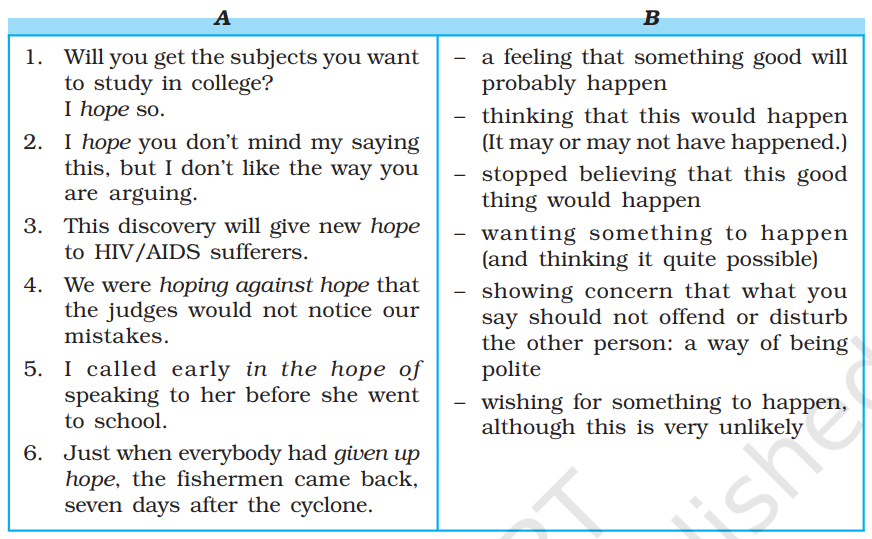
Correct Matching:
- Will you get the subjects you want to study in college? I hope so.
✅ thinking that this would happen (It may or may not have happened.) - I hope you don’t mind my saying this, but I don’t like the way you are arguing.
✅ showing concern that what you say should not offend or disturb the other person - This discovery will give new hope to HIV/AIDS sufferers.
✅ a feeling that something good will probably happen - We were hoping against hope that the judges would not notice our mistakes.
✅ wishing for something to happen, although this is very unlikely - I called early in the hope of speaking to her before she went to school.
✅ wanting something to happen (and thinking it quite possible) - Just when everybody had given up hope, the fishermen came back, seven days after the cyclone.
✅ stopped believing that this good thing would happen
III. Relative Clauses (Joining sentences)
- I often go to Mumbai. Mumbai is the commercial capital of India. (which)
➡ “I often go to Mumbai, which is the commercial capital of India.” - My mother is going to host a TV show on cooking. She cooks very well. (who)
➡ “My mother, who cooks very well, is going to host a TV show on cooking.” - These sportspersons are going to meet the President. Their performance has been excellent. (whose)
➡ “These sportspersons, whose performance has been excellent, are going to meet the President.” - Lencho prayed to God. His eyes see into our minds. (whose)
➡ “Lencho prayed to God, whose eyes see into our minds.” - This man cheated me. I trusted him. (whom)
➡ “This man, whom I trusted, cheated me.”
IV. Using Negatives for Emphasis
Find sentences from the story that mean the following:
- The trees lost all their leaves.
➡ “Not a leaf remained on the trees.” - The letter was addressed to God himself.
➡ “The letter was addressed ‘To God’.” - The postman saw this address for the first time in his career.
➡ “Never in his career as a postman had he seen a letter addressed to God.”
V. Metaphors
In pairs, find metaphors from the story to complete the table below. Try to say what qualities are being compared. One has been done for you.
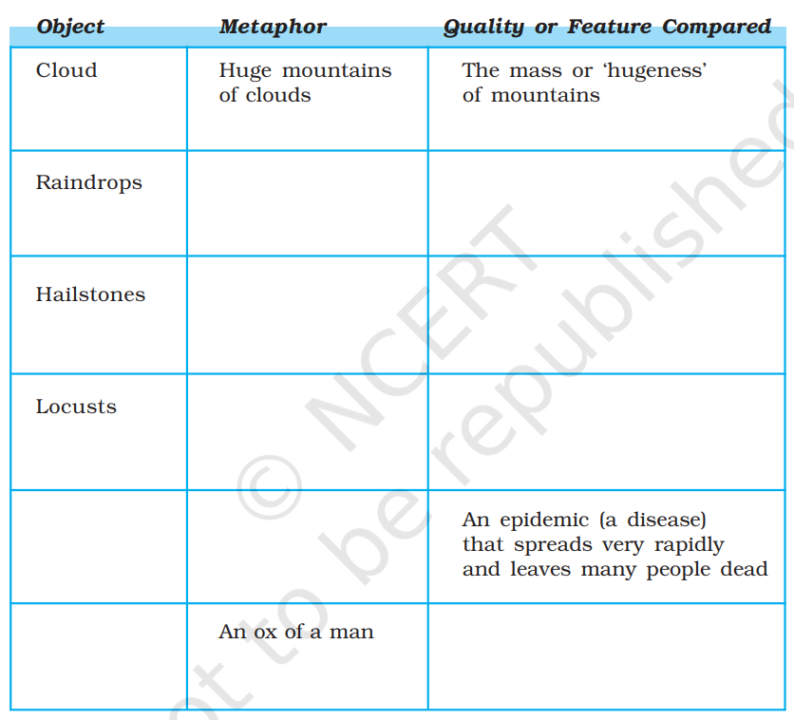
Completed Table:
| Object | Metaphor | Quality / Feature Compared |
|---|---|---|
| Cloud | Huge mountains of clouds | The mass or hugeness of mountains |
| Raindrops | New coins | Value and usefulness |
| Hailstones | Frozen pearls | Shape, size, and whiteness |
| Locusts | A plague of locusts | Complete destruction |
| Crop destruction | An epidemic | Sudden spread and total damage |
| Lencho | An ox of a man | Strength and hard work |
NOTE: The Speaking, Listening, and Writing section of this chapter is activity-based questions that should be done by yourself in the classroom with the help of a teacher.