Today, in this blog post ‘The Beggar Summary Class 9 English’, we’ll read short & detailed summary of the chapter The Beggar writen by Anton Chekhov from Class 9th NCERT English Moments(supplementary) Chapter 9 that will help you to understand this chapter better so that you can score best in your exam.
This post is a complete and easy-to-understand guide for your Class 9 English Moments Chapter “The Beggar”.
The Beggar About the Chapter
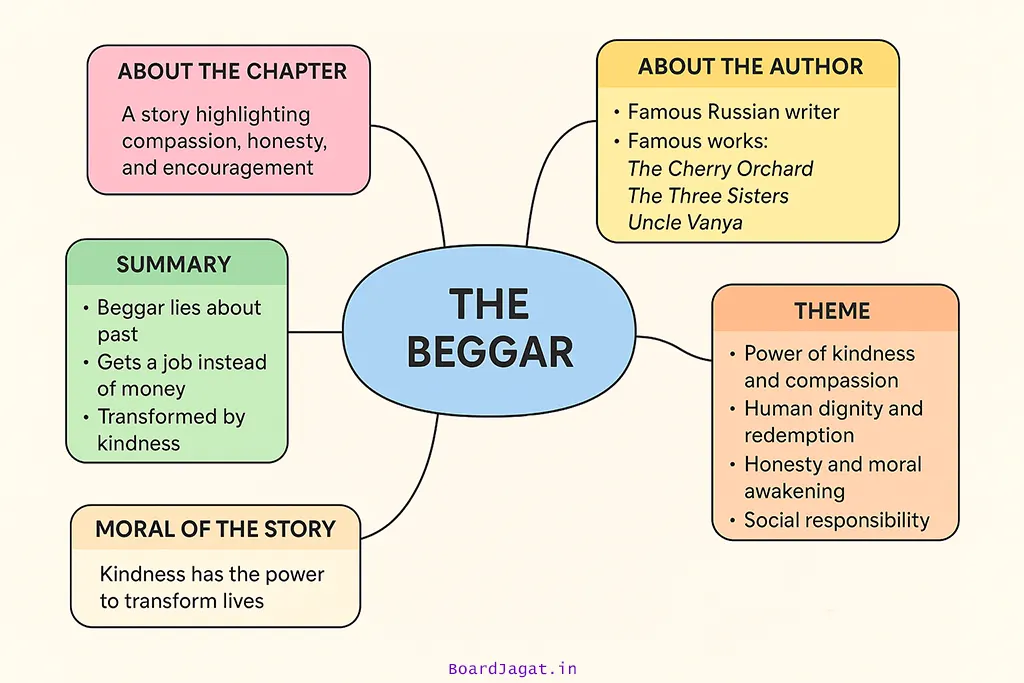
“The Beggar” is a heart-touching story written by Anton Chekhov that highlights how compassion, honesty, and encouragement can reform even the most hopeless person. The story revolves around Sergei, a kind advocate, and a beggar named Lushkoff, who used to lie and drink. Through Sergei’s help and his cook Olga’s kindness, Lushkoff transforms from a drunkard beggar into a hardworking, respectable man.
About the Author – Anton Chekhov
Anton Pavlovich Chekhov (1860–1904) was a famous Russian short-story writer, playwright, and physician. He is considered one of the greatest short-story writers in world literature. His works often focus on everyday people, moral struggles, and social realities. Chekhov’s writing style is simple, realistic, and full of human emotions.
Famous works: The Cherry Orchard, The Three Sisters, Uncle Vanya, and The Seagull.
Short Summary of The Beggar
The story begins when a beggar named Lushkoff approaches a lawyer, Sergei, begging for money by lying about his past. Sergei recognizes him as a liar and angrily scolds him. Instead of giving him money, Sergei offers him work, chopping wood.
Although weak and unwilling, Lushkoff agrees out of shame. Sergei’s cook Olga helps him with the work and even does most of it herself, but she also scolds and cries for him out of sympathy. Sergei continues to give Lushkoff odd jobs, and later helps him get a decent copying job.
Years later, Sergei meets Lushkoff again and learns that he has become a notary earning well. Lushkoff thanks Sergei but reveals that it was Olga’s compassion and care that truly reformed him. Her tears and kindness awakened his conscience and made him give up drinking.
The Beggar Summary
The story “The Beggar” by Anton Chekhov is about how kindness and compassion can reform even the worst of people. It tells us the journey of a poor beggar named Lushkoff and how he changes his life with the help of an advocate Sergei and his cook Olga.
Beginning of the Story – The Beggar and His Lies:
The story begins with a beggar named Lushkoff pleading for help from a lawyer named Sergei. He tells Sergei that he had once been a village schoolteacher but lost his job because of false accusations. He claims he hasn’t eaten in three days and needs money to travel for a new job offer.
However, Sergei recognizes him. Just a few days earlier, the same beggar had told him a different story, saying he was a student who had been expelled. Realizing that Lushkoff is lying, Sergei becomes angry and accuses him of dishonesty and cheating.
Lushkoff admits the truth; he confesses that he had been a singer in a choir but was thrown out because of drunkenness. He lies because nobody helps him when he tells the truth.
Sergei Gives Him Work:
Instead of giving him money, Sergei decides to teach him a lesson and help him reform. He offers him work chopping wood. Lushkoff agrees, not because he really wants to work, but out of shame and pride, as he has been caught lying.
Sergei orders his cook, Olga, to take the beggar to the woodshed. From the window, Sergei watches them. He sees that the beggar is weak and unfit for the hard job. Olga scolds him angrily, but she also feels pity for him. Eventually, Olga herself chops the wood for him but pretends that Lushkoff did it.
Lushkoff Keeps Coming Back:
After that day, Lushkoff starts visiting Sergei’s house regularly. Sergei gives him small jobs like shoveling snow, cleaning, and moving furniture. Each time, Sergei pays him some money for his work. When Sergei moves to a new house, he even hires Lushkoff to help with packing.
Sergei notices that Lushkoff is now sober and quiet, no longer drunk. Sergei is pleased that his words and support are having a positive effect. He then helps Lushkoff get a proper job as a copywriter by giving him a recommendation letter. Lushkoff takes it and leaves.
Two Years Later: Lushkoff’s Transformation:
Two years pass. One evening, Sergei sees Lushkoff at a theatre buying a ticket. Lushkoff looks decent and confident. Sergei is surprised to learn that he is now working as a notary and earns thirty-five roubles a month, a good salary.
Sergei feels proud and says he is glad his advice changed Lushkoff’s life. But Lushkoff corrects him. He says that Sergei helped him, but the real credit goes to Olga, the cook.
Olga’s Hidden Kindness:
Lushkoff reveals that when he used to come to Sergei’s house, Olga would scold him, cry for him, and pray for his well-being. She would call him a drunkard and warn him that he was ruining his life but deep down, she felt pity and love for him.
He also confesses that he never actually chopped the wood himself, Olga did it for him every time. Her tears, her kindness, and her pain touched his heart deeply. He realized how far he had fallen and decided to change his life completely. Her emotional support gave him the courage to quit drinking and work honestly.
Lushkoff ends by saying that it was Olga’s compassion that truly saved him and reformed his character.
Conclusion:
“The Beggar” beautifully shows that people do not change through anger or punishment but through love, empathy, and patience. Sergei gave Lushkoff a chance, but it was Olga’s heartfelt care that awakened his conscience and made him a better human being.
View: all Chapter Summary of Class 9th English
The Beggar Theme
The main themes of the story are:
- Power of kindness and compassion: Genuine sympathy and care can bring about transformation.
- Human dignity and redemption: Everyone deserves a second chance to reform.
- Honesty and moral awakening: Truth and self-respect help one rebuild life.
- Social responsibility: Helping others to stand on their feet is nobler than giving charity.
Moral of the Story
- True change comes from love, compassion, and encouragement, not punishment.
- A person can reform if given understanding and a chance to work with dignity.
- Helping others selflessly can bring great positive change in society.
- Kindness has the power to transform lives.
Read Also: The Beggar NCERT Question Answer